MASTER: Sustainability and energy management in construction works
AUTHOR: Arch. Marco Guerra
TUTOR: Prof. Paola Ronca
The climate crisis is now widely acknowledged as one of the most pressing issues of our time. The construction sector significantly contributes to global greenhouse gas emissions. In recent decades, efforts have primarily focused on reducing the “operational” emissions of buildings, achieving remarkable levels of energy efficiency, especially in new constructions. However, when considering the entire life cycle of buildings, there has been a lack of equally effective strategies to reduce “embodied” emissions – those associated with the production of materials and building components, the construction process, and, ultimately, the demolition. This study addresses this issue by first providing a general overview, then selecting Switzerland as an exemplary field of observation, and finally presenting two in-depth case studies that explore innovative approaches to the topic.
To address the urgent need to reduce embodied emissions, the most commonly adopted solution to date has been the broader use of timber construction. This thesis starts by examining the advantages and limitations of this technology, highlighting how it can only offer a partial response to the problem. More promising are strategies that – regardless of the construction material employed – focus on extending the life cycle of buildings or part of them. By associating high initial emissions with a longer useful life, even traditionally high-impact construction technologies can become sustainable once again.
In this context, all experiments aiming to adopt circular economy principles in the construction sector are of particular interest. Within the wide array of strategies summarized by the “10 Rs” of circularity, this thesis concentrates mainly on the practice of Reuse of building components, illustrating its vast and largely unexplored potential. The most suitable tool to assess the climate impact of each building component is the Life Cycle Assessment (LCA). A thorough understanding of its methodological and regulatory aspects is necessary in order to apply it effectively in design decisions, including – as done in the case studies – a comparative evaluation across different construction technologies.
The first section ends by analyzing how circularity is assessed within major international certification systems (LEED BD+C and BREEAM) as well as Swiss ones (SNBS and Minergie®), noting how attention to the entire life cycle has been steadily increasing in recent years.
The second section focuses on the specific relevance and interest of the “Swiss case” in relation to the thesis topic. Starting from the severe effects of climate change on the Alpine region and a widespread public awareness of sustainability, the section explores the unique and multifaceted ecosystem of Swiss public design competitions. In recent years, this system has fostered the emergence of experimental proposals addressing circular construction, facilitating access for younger designers, who often bring forward the most innovative ideas. In particular, the reuse of construction components in Switzerland is especially justified by the common practice of demolition and reconstruction, enabled by a more concentrated land ownership structure compared to Mediterranean countries and by specific legal and financial incentives.
To fully understand the subsequent case studies, this section also outlines both European (New European Bauhaus) and Swiss (Baukultur strategy and the Federal Law – Locli) circularity initiatives, as well as the technical norms developed by the SIA (Swiss Society of Engineers and Architects) and the KBOB (Conference of Public Sector Clients at Federal Level). These have a strong influence on professional practice in Switzerland, introducing, among other things, a maximum threshold for embodied emissions over the entire life cycle (9 kg CO₂ eq./m² EBF [energy-related floor area]/year), a clear definition of the life cycle stages, as well as standardized databases and calculation tools that can be employed as early as the competition phase. This theoretical-regulatory section is substantiated by five significant examples of winning public competition projects that embrace the reuse of construction components as a central design strategy.
The third section presents an in-depth analysis of two school building projects currently under development in Switzerland, in which the thesis author – together with other partners – is actively involved as a designer. In both cases, reuse is adopted as a key strategy, albeit in very different ways, making both case studies particularly exemplary.
The first project concerns the future Kindergarten and Primary School in Zuoz, a small village in the Engadine Valley, located in the mountainous canton of Graubünden. The entire Alpine region is now heavily affected by climate change, with decreasing winter snow cover and the growing obsolescence of low-altitude ski resorts. In Switzerland alone, 65 decommissioned ski lift systems have been identified, many of which remain abandoned in the natural environment due to economic and regulatory constraints. This project proposes to reuse the steel trusses from these decommissioned systems as the vertical load-bearing structure of the new school building. This strategy has a dual benefit: it contributes to the renaturalization of the fragile ecosystems currently hosting these infrastructures, and it transforms them into a low-impact resource for the new construction. Using them for a school building also symbolically embodies a responsible and forward-thinking cultural model in relation to the natural landscape.
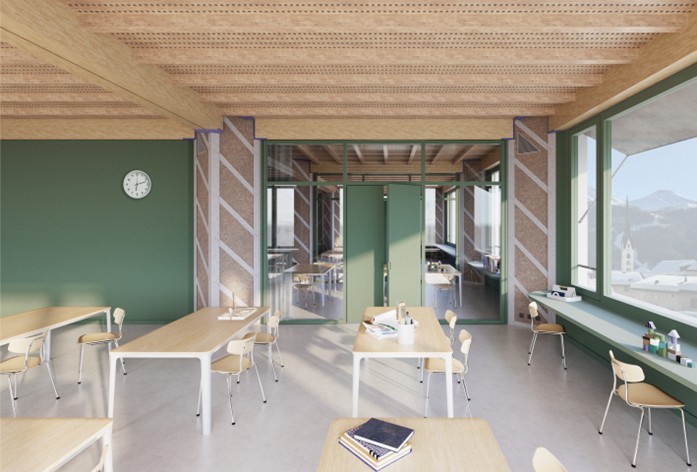
Within the design competition, the reuse strategy was part of a broader set of sustainability-oriented design choices: compact volume, spatial and programmatic flexibility, construction using reduced resources, glue-free solid timber slabs, the absence of a basement level, utilization of the existing terrain configuration, and a passive thermal strategy based on optimal solar orientation. All these elements contribute to significantly reducing emissions over the building’s entire life cycle.
The case study includes a detailed analysis of the reuse process for the steel trusses on every specific phase: identifying suitable resources and assessing the feasibility of reuse; studying their geometric, structural, and regulatory compliance; planning the dismantling process; adapting the components and integrating them into a new construction system. This methodology was tested concretely using a lift system from the decommissioned Hospental-Winterhorn ski area near the Gotthard Pass. A structural analysis of the typical reused element within the new load-bearing system was carried out, along with a fire resistance solution involving the filling of the pillars with recently patented cement-free stabilized earth concrete (Cleancrete®). Finally, a comparative LCA was performed to evaluate the proposed structure against two alternative variants in timber and reinforced concrete. The results clearly demonstrate the superior performance of the reuse-based solution over both traditional alternatives.
The second project, of bigger scale and importance, involves the extension of the Technical and Vocational School of Bülach, a town in the greater Zurich metropolitan area. This upper-secondary institution trains mechanical and electronic technicians who often go on to work in the region’s high-tech industrial sector, closely linked to Zurich Airport. Not coincidentally, the existing school building – dating from the 1970s – features an exposed steel structure and an elaborately detailed continuous panels façade panels, and is listed by the heritage authority as one of the most significant examples of high-tech architecture in Switzerland.
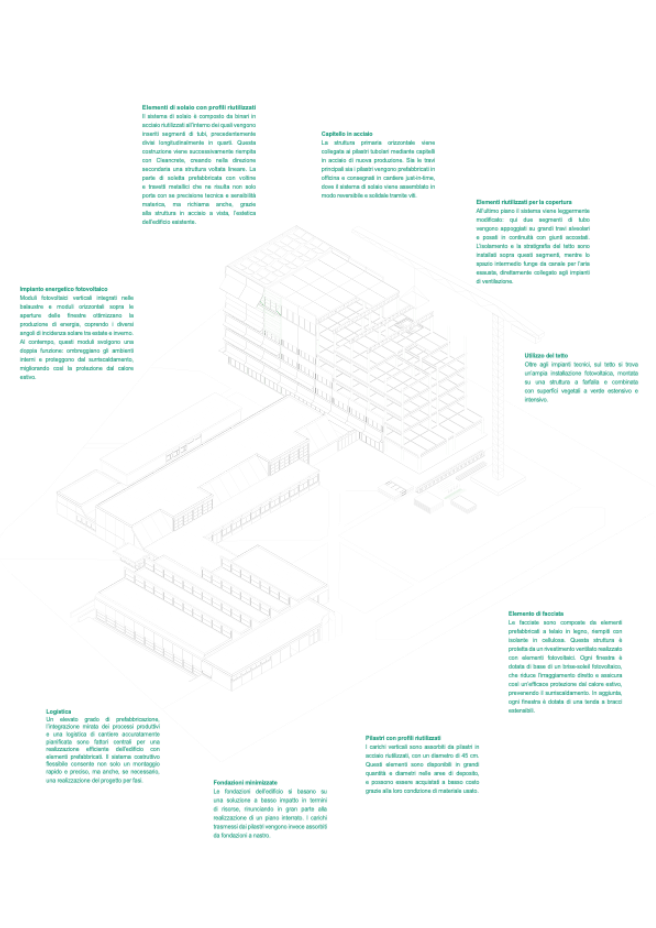
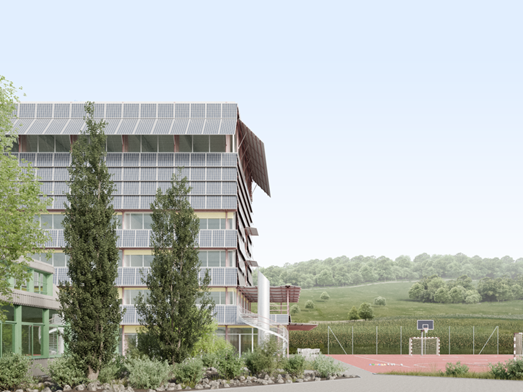
The new structure also uses steel and once again adopts a reuse strategy – though in a completely different form than in the Zuoz project. To address material scarcity, the design proposes reusing steel tubular profiles – mass-produced for fossil fuels transport infrastructure, now increasingly being decommissioned due to the energy transition. These tubular elements, available in various dimensions, are employed both as vertical load-bearing pillar and as lost formwork for the precast floor slabs, as well as substructure for the photovoltaic panels that fully clad the building envelope, becoming the architectural hallmark of the proposal.
Here too, the reuse strategy is part of a broader set of sustainable design choices: spatial efficiency, compact form, separation of systems according to different life cycles, design for disassembly, spatial flexibility, the absence of underground parking, the use of low-tech systems for building operation, and photovoltaic coverage across the entire envelope, transforming the building into an energy-generating hub for the surrounding district. All these measures contribute to limiting climate-affecting emissions, achieving a remarkable result for embodied emissions of just 6.7 kg CO₂ eq./m² EBF/year, well below the ambitious SIA target of 9 kg CO₂ eq./m² EBF/year.
To assess the efficacy of the reuse strategy, this project also underwent a comparative LCA analysis, comparing the proposed structure with two alternative versions in timber and concrete. Once again, the results – based on data and obtained using tools provided by the KBOB – confirm the effectiveness of the innovative solution, even under conservative assumptions that limited reused components to only 50% of the required tubular elements.
Two key conclusions emerge from this thesis. First, the findings derived from the case studies and their project data analyses conducted using established methodologies demonstrate the viability of applying circularity – and specifically the practice of component reuse – to effectively reduce life-cycle greenhouse gas emissions. Second, the presentations of the case studies were not limited to this single aspect but encompassed the full range of architectural and technical choices that contribute to minimize the environmental impact of the proposals. This underscores that a holistic approach is essential if we are to make building activity genuinely sustainable.