
TITLE OF THE MASTER THESIS: The Impact of the Absence of BIM and Digital Integration on Large-Scale Construction Projects, a practical Case Study of the International Garden Project
TITLE OF THE MASTER: Project management in construction works with BIM
AUTHOR: Samer Rashad Abdulkareem Yadk
TUTOR: Ing. G. Franchi
The increasing scale and complexity of contemporary construction projects require advanced coordination mechanisms capable of integrating architectural, structural, mechanical, and environmental systems into a coherent execution framework. Traditional document-based project delivery methods—primarily dependent on 2D drawings and fragmented information flows—often struggle to provide the level of visualization, coordination, and decision-support required for such complex environments. Building Information Modeling (BIM) has therefore emerged as a central element of digital transformation in the construction industry, enabling integrated project visualization, multidisciplinary coordination, and data-driven decision-making across the entire project lifecycle.
This research investigates the managerial, operational, and investment-related consequences of executing a large-scale construction project in the absence of BIM and integrated digital systems. The study is structured as an applied professional case study centered on the International Garden Project, a large experiential development designed to recreate multiple geological eras through immersive landscape environments. The project represents a technically demanding construction environment characterized by complex spatial geometry, integrated environmental control systems, and multidisciplinary construction coordination requirements.
The research adopts a practice-oriented methodology based on the analysis of real project documentation, including construction drawings, planning schedules, change orders, site observations, and execution records. The International Garden Project serves as the principal analytical case, while selected comparisons are drawn with other BIM-enabled projects in order to illustrate the operational differences between traditional document-based construction management and digitally integrated project delivery systems.
From a management engineering perspective, the study demonstrates that the absence of early-stage BIM visualization significantly affects the accuracy of project pricing, constructability assessment, and procurement planning. Without integrated digital models, project stakeholders must rely on fragmented information sources, which increases the likelihood of estimation inaccuracies and reduces the ability to foresee interdisciplinary coordination challenges during the tendering and planning stages. This research therefore positions BIM not merely as a design visualization tool but as a strategic management engineering instrument that supports informed decision-making and risk reduction throughout the project lifecycle.
The execution phase analysis constitutes the core practical contribution of the thesis. Through multiple real-site cases documented during construction, the study illustrates how the absence of federated BIM coordination resulted in workflow instability, design conflicts, and repeated construction adjustments. Among the documented cases are structural slab penetrations required for mechanical and plumbing systems, misalignment between drainage installations and architectural finishing layouts within the visitor toilet buildings, and geometric coordination challenges associated with boundary wall structures and service installations. These cases demonstrate how spatial coordination problems often emerged only during construction, when corrective actions became significantly more costly and disruptive to the construction schedule.
Beyond individual technical conflicts, the study also analyzes broader project management implications related to coordination instability, increased Requests for Information (RFI), and disruptions in construction sequencing. The research highlights how the absence of integrated digital coordination amplified the limitations of traditional linear project management structures such as the Waterfall approach, particularly in projects experiencing frequent design modifications. By contrast, BIM-enabled environments provide a foundation for more adaptive management approaches, including Agile-oriented coordination and iterative decision-making processes.
The thesis further examines the role of field-level digital technologies in improving execution intelligence in mega-scale construction projects. In the absence of advanced surveying technologies, digital terrain modeling, and integrated data environments, the International Garden Project experienced increased labor intensity, geometric inaccuracies, and higher risks of rework during construction. These findings emphasize the importance of digital field integration as a structural requirement for achieving precision and stability in large-scale project execution.
From a regulatory and governance perspective, the research analyzes international BIM standards—particularly ISO 19650—and the evolving regulatory framework supporting BIM adoption in Saudi Arabia under Vision 2030. The study demonstrates how structured information management systems, model maturity control, and standardized digital workflows could significantly reduce the coordination failures and execution risks observed in the International Garden Project.
The research also explores performance optimization frameworks that integrate BIM with Lean Six Sigma principles. By combining 3D model coordination with 4D schedule simulation and 5D cost integration, construction processes can be transformed into measurable and controllable systems characterized by reduced variability and improved productivity. This integration enables the application of structured quality management methodologies such as the DMAIC cycle to construction project execution.
Extending the analysis beyond the construction phase, the thesis examines advanced BIM maturity levels including 6D and 7D BIM. These dimensions incorporate sustainability analysis, lifecycle performance evaluation, and operator integration into the digital model, allowing construction projects to transition from short-term execution focus toward long-term asset management and lifecycle optimization.
Building upon the lessons derived from the International Garden Project case study, the research proposes a BIM-driven virtual investment framework for residential villa development. This model integrates digital visualization, scheduling simulation, and cost control mechanisms to reduce investment uncertainty and enable more reliable project planning and decision-making processes. By transforming fragmented project data into structured digital information, the proposed framework demonstrates how BIM can support both construction efficiency and investment value optimization.
The main conclusions and lessons learned
The findings of this research confirm that the absence of BIM and digital integration in large-scale construction projects leads to measurable impacts on coordination stability, schedule performance, cost predictability, and managerial decision-making efficiency. Conversely, digitally integrated environments enable proactive clash detection, improved interdisciplinary collaboration, and enhanced control of project time, cost, and risk performance.
Ultimately, this thesis demonstrates that BIM should not be regarded merely as a technological enhancement within the design process. Instead, it represents a comprehensive management and investment framework capable of transforming construction projects from reactive execution environments into structured, data-driven systems that support predictability, operational stability, and long-term value creation in modern construction practice.
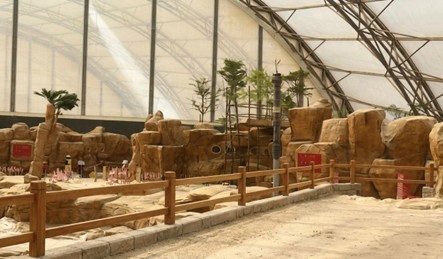
(Figure 1) This image illustrates the integration between architectural elements and the supporting structural system. The architectural features are fully coordinated with the building services, including HVAC systems, lighting, oxygen sensors, drainage and irrigation pipes, and concealed fire-fighting hoses. All these systems are carefully integrated within the architectural details to create a realistic and immersive experience for visitors.
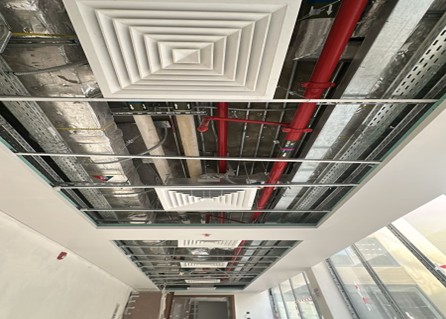
(Figure 2) This image demonstrates the importance of the 3D model in coordinating building services, resolving clashes between different systems, and organizing all networks efficiently within the limited space of the suspended ceiling.

(Figure 3) 3D modeling in creating a new investment environment by presenting the future project through VR technology. This allows stakeholders and clients to visualize the project, request modifications, and reach full satisfaction before actual construction begins. also enables the provision of a preliminary schedule, cost estimate and reduce risks.