Authors:
1) Esq. PMP® Grace Castro Rojas
2) Eng. PMP® Angelo Jesús Ismael Duarte Di Rosa
3) Esq. Juan Carlos Medina Flores
Tutor: Ing. Giovanni Franchi
Master: “CONTRACT, CLAIM, AND DELAY MANAGEMENT IN CONSTRUCTION WORKS”
Student Year: 2023/2024
In Peru, regardless of the applicable legal regime, there is a tendency in public works to have several disputes, lack of collaboration between the parties, little flexibility and, above all, a serious lack of efficient management tools.
In this thesis, we seek to demonstrate how it is possible to implement in public works different contract and project management tools, in order to improve efficiency.
For this purpose, we will analyse three hospital projects. First, two hospitals (procured as a package) executed under a government-to-government scheme, in which an NEC contract has been used, but where the public entity (client) has not understood the philosophy and tools of this type of contract.
On the other hand, we will analyse a typical project executed under the Peruvian Public Procurement law, in which the tools and spaces for cooperation are quite limited, but we found room to implement some tools to improve the management.
Although in Peru the management of this type of project may be seen as different, we will demonstrate how in both cases tools can be implemented to prioritize project objectives over individual interests.
So, after the analysis between the projects for the improvement of the construction of public hospitals in Peru: “HOSPITALES DE POMABAMBA Y YUNGAY” and “HOSPITAL DE
CAJAMARCA”, the following is concluded:
– In the Pomabamba and Yungay hospitals project, an NEC ECC Option F Contract has been used, which allows the use of greater collaboration and joint project management tools, in order to obtain efficiencies and achieve project results. However, despite having the tools provided by the chosen contract model at their disposal, the parties were not fully prepared for their use, which did not allow for proper project management.
In this case, we highlight the use of contractual tools in the NEC such as early warning and risk management, stakeholder management, the use of compensable events, and the use of the Disputes Adjudication Board.
– On the other hand, in the case of the Cajamarca hospital, the parties considered that only the provisions of the public procurement regulations had to be complied with in order to achieve the success of the project. However, compliance with the regulations alone does
not generate sufficient incentives to generate efficiencies in the administration of the project and meet its objectives. Hence, even under a strict and seemingly inflexible contracting regime, there is the possibility of implementing strategies and tools that align the interests of the parties towards the achievement of the common benefit.
In this case, we highlight contractual management tools that could have been implemented, as they were compatible with this type of traditional contracts, such as early warning management and risk management, as well as stakeholder management, which are very useful to reduce impacts on time and/or costs in the Project. We also highlight the impossibility of using the tools for managing deadlines and disputes of the colaborative contracts, considering that the traditional regime has a different regulation and it’s not compatible.
– From our analysis, we can conclude that, despite the legal regime, the proactivity, skills and engagement of the professionals are more important than the type of contract, in order to success in a construction project. There is always a possibility to improve the project management.
Contrary to what is currently believed in Peru, the contract model used does not ensure the success of a project. It is just one tool that parties should properly choose and use. If the parties use sophisticated contracts or complex collaboration tools, but they do not have teams prepared for it, the project will probably end up failing.
In addition, inflexible regulations do not prevent the parties from coordinating adequately during project execution and implementing tools to achieve common benefits. There is always room for improvement in project management, all that is required is the ability and willingness to cooperate.
We also believe that if good practices on collaborative contract management (such as risk management and early warnings, and stakeholder management) were implemented in traditional contracts, we could obtain better results in Project management, especially considering that they are compatible with all types of projects and are recognized as international good practices.
An essential element that in Peru conditions the success of a project and the possibility of obtaining efficiencies is the public functionaries’ fear of the Comptroller General of the Republic. A functionary afraid of being sanctioned administrative, civil and criminally, will not have any incentive to carry out a real management, but will take refuge in strict compliance with the rules and the denial of any value proposition.
It is important to gather experiences in projects executed under international construction standard contracts in order to make proposals to improve national regulations, with the aim of having an efficient management of public works.
In our thesis, we demonstrate that, despite of the contract form used, it is possible to success in the execution of public projects. This is important, since the center of the discussion in the new public procurement regulation is the implementation of International Standard Contracts in Peru.
Even when the Hospital of Pomabamba and the Hospital of Yungay were procured using NEC ECC Contract, there were many problems during their execution that had to be dealt by the contractor and employer’s teams, acting collaboratively.
For example, there were problems with the appointment of the DAB, financial problems of the project due to the delay in the advanced payment, COVID-19 effects on the performance, among others.
Despite all these problems, the Yungay and Pomabamba’s hospitals (International standard contracts in Peru – NEC), as well as the Cajamarca’s hospital (Public contracts laws (Traditional contract in Peru), even where the applicable law is different, were well managed and the progression of the works of the three projects could continue. Currently, the takeover of these three important projects for the public health of vulnerable populations of Peru is almost closed, as can be seen in the following pictures:
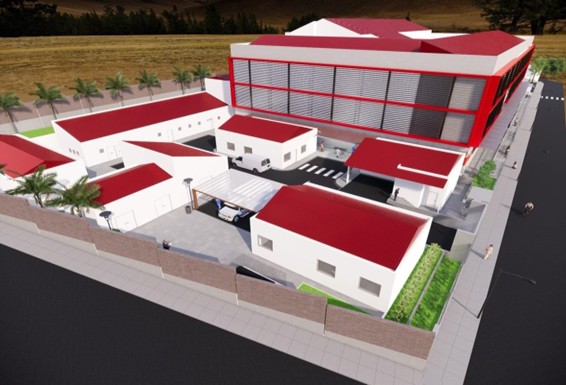
Figure N° 1: 3D model of the Yungay hospital and its different components, you can also see the routes that allow internal transfers.
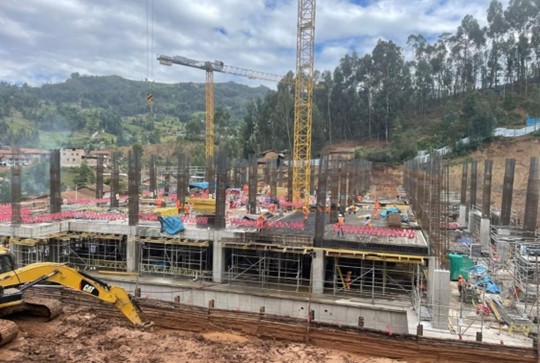
Figure N° 2: Pomabamba’s Hospital: The image shows a building with steel installed, slab formwork assembled, and tower cranes transporting construction materials for the construction of the hospital. Likewise, the backhoe is working on the construction of this important hospital.
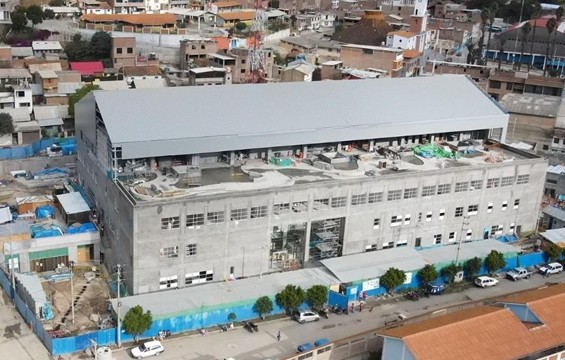
Figure N° 3: Yungay’s Hospital: The level of construction is advanced, architectural works can be seen that correspond to the final stage of the project closure.
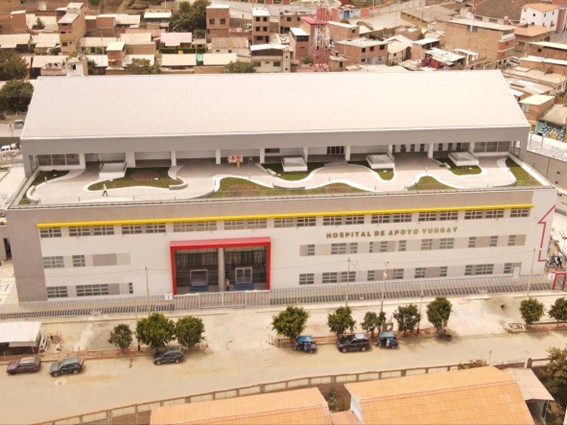
Figure N° 4: Yungay’s Hospital: Recent Front view of the hospital.
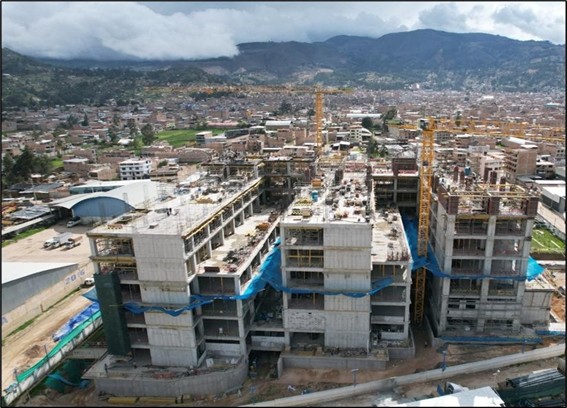
Figure N° 5: Cajamarca’s Hospital: There are several fronts working in parallel, with an intermediate level of progress.
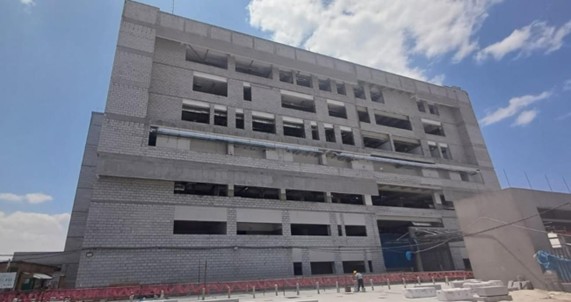
Figure N° 6: Cajamarca’s Hospital: Work with intermediate level of progress.