MASTER: Project and Contract management in construction works with BIM
AUTHOR: Lovell Delia
TUTOR: Eng. Franchi
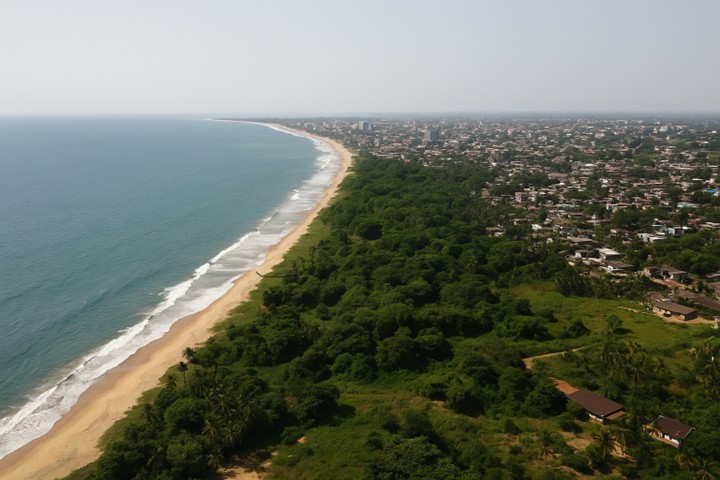
A coastal building site in Liberia, Africa, at the intersection of architecture, energy systems, and digital finance, the Charles D. B. King Center for Ecological Sustainability and World Trade emerges as a bold prototype for how buildings can think, generate, and invest in their own futures. Commissioned by Tara King-Haagen in honor of her great-grandfather, Charles D. B. King—the 17th President of Liberia and a pioneering African diplomat at the United Nations—the project aims to serve as a scalable model for climate-adaptive construction and localized technological sovereignty. Now in the Planning and Design Phase, the Center is slated for completion in April 2027, coinciding with the 10-year anniversary of the demolition of Raj Rewal’s original Hall of Nations in New Delhi, India. This timeline casts the project not just as innovation—but as a defiant resurrection, rewriting history through architecture, technology, and power.
The King Center marks the first real-world application of the Generative Power
Construction Framework (GPCF)—a modular, AI-integrated system that unifies digital fabrication, intelligent building controls, energy asset generation, and adaptive management. I designed this framework in the Master’s program for the King Center project. The King Center’s stepped pyramid façade will be clad in photovoltaic solar glass, replacing traditional concrete with programmable infrastructure capable of producing and storing power within an interconnected microgrid system. These energy reserves, designed to interface with smart utility systems, will support EV charging infrastructure, commercial leasing platforms, and community training zones equipped for the delivery of emerging technology and digital construction skills.
These embedded capabilities directly address infrastructure gaps and labor market deficiencies across Africa.
The University of Liberia, Liberia’s national utility company, and the Port of Monrovia are active stakeholders, contributing operational alignment and local integration across power distribution, trade logistics, and workforce development. The project also includes climate research laboratories that will monitor and model the regional impacts of climate change in West Africa, with a focus on real-time environmental data, resource stress mapping, and resilience planning.
Computationally, the Center employs a federated digital twin connected to a network of sensors and autonomous control protocols developed using the TASTE (The ASSERT Set of Tools for Engineering) an engineering framework from the European Space Agency. Originally designed to control Mars rovers, this cyber-physical interface serves as a station for all data and sensors on the site augmented by custom AI algorithms—developed during this graduate research—that enable real-time optimization of power management, structural load monitoring, building envelope response, and decentralized contract execution. These systems reframe the building not as a static entity, but as a responsive, data-driven machine ecology embedded in local and global financial networks.
Mathematical Model
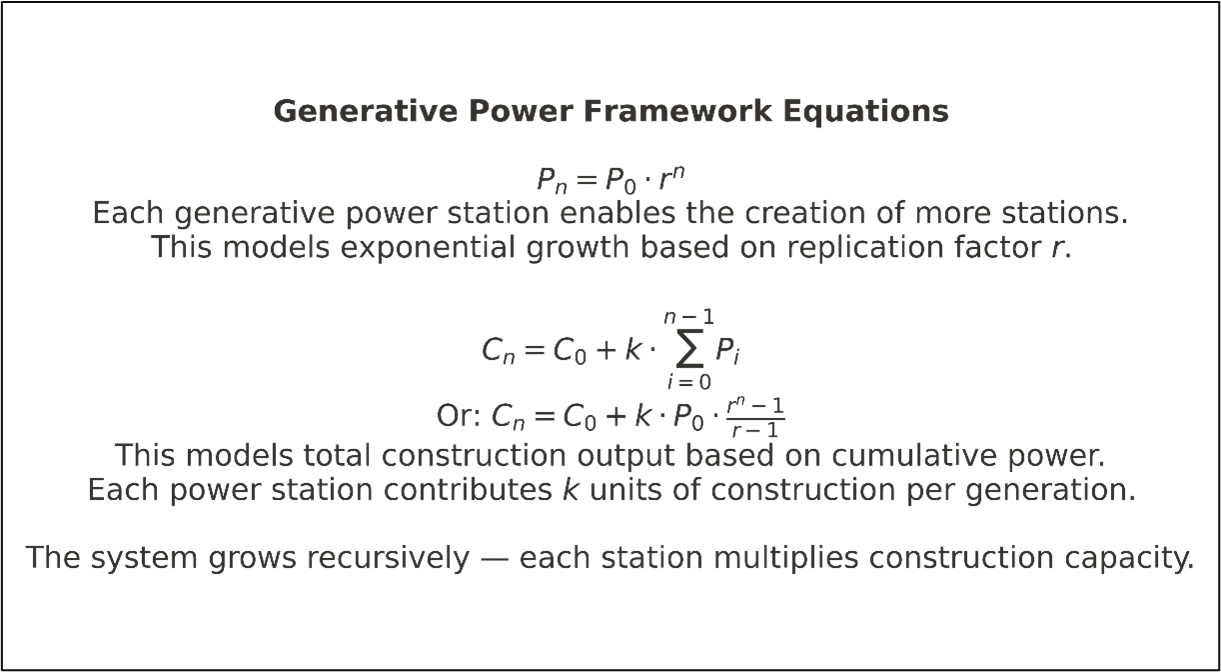
Mathematical Formula for the Generative Power Construction Framework
In the Generative Power Construction Framework, this pair of equations means:
- Every new generative power station increases the ability to build more stations and infrastructure.in the project.
- The AI system learns and grows recursively — each unit adds to capacity and to production, forming a feedback loop.
- The growth is nonlinear and can accelerate dramatically if replication factor rrr is greater than 1.
- Economically, the King Center functions as a programmable asset, with surplus energy, carbon offsets, and operational metadata tokenized and transacted in blockchain-secured derivatives markets and decentralized energy finance platforms. This positions the building as a liquid, tradable infrastructure instrument, capable of attracting clean capital investment to the region while fostering financial transparency, digital literacy, and sovereign ownership of energy resources
Conclusion and Lessons Learned
This case study on the King Center for Ecological Sustainability and World Trade concludes with confidence that the Generative Power Construction Framework represents a significant contribution to construction management theory and practice. The framework provides both theoretical insights and practical tools that can transform construction outcomes while creating lasting value for communities, investors, and the environment.
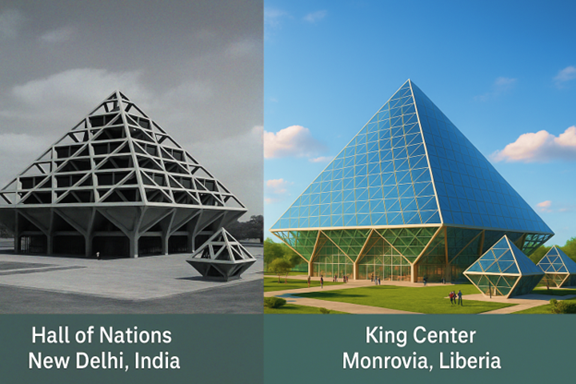
Original Hall of Nations in New Delhi comparted to The King Center in Monrovia, Liberia