

TITLE OF THE MASTER THESIS: EoT and Disruption Claims in Qatar for Mega Infrastructure Projects
TITLE OF THE MASTER: Contract, Claim, and Delay Management in Construction Works
AUTHOR: Ayman Nadim
TUTOR: Ing. Franchi
Effective claim management is a critical component of contract administration in large infrastructure projects. In environments where evolving scopes, access constraints, and multiple stakeholders converge, delay and disruption are almost inevitable despite careful planning. Recognizing, documenting, and substantiating claims within a proper contractual and legal framework is essential for protecting entitlements and managing commercial risk. In public infrastructure works governed by bespoke contracts influenced by FIDIC principles, a disciplined approach is required to maintain both contractual rights and working relationships.
Introduction to the Thesis and Scope of Study
This Master’s thesis examines the administration of Extension of Time (EoT), Prolongation cost, and Disruption Claims within the context of large-scale infrastructure works procured under bespoke lump-sum contracts influenced by FIDIC principles and governed by Civil law. The study focuses on a mega infrastructure project involving complex interfaces, multi-disciplinary scopes, and prolonged execution timelines. Delays arose from access constraints, iterative design development, and late approvals by various stakeholders. The claim analysis was supported by forensic delay assessment through Time Impact Analysis (TIA), conducted in accordance with the contract’s procedural framework and legal obligations under the Qatari Civil Code. Central to the thesis is the evaluation of a comprehensive EoT submission, incorporating causation analysis, concurrency assessment, and entitlement review. The objective is to extract practical lessons for the effective preparation, substantiation, and defense of time and cost claims on major public infrastructure contracts.
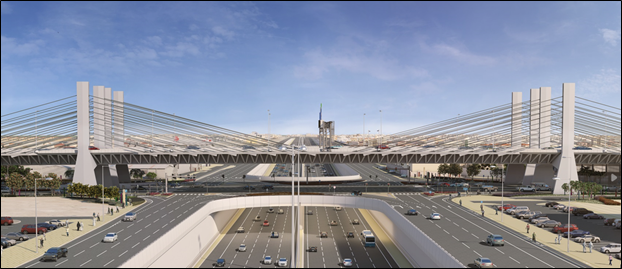
- Project Perspectives as Landmark Project – Cable Stay Part
Baseline Programme, EoT, Concurrency Prolongation and Disruption
Baseline Programme:
Effective delay analysis and programme management are essential in complex construction projects. A reliable baseline programme, regularly updated, supports entitlement to time and cost claims. The approach must link delays to actual construction logic, not just design or procurement stages. Accurate monthly updates, identification of critical and near-critical paths, and logical sequencing are necessary to defend against concurrency and demonstrate causation.
The thesis highlights that a reliable baseline must be established at project commencement, reflecting the full contractual scope and accurate construction sequencing. All work elements, including minor scopes with potential delay risk, should be included. Key Stages must be clearly defined, and in the absence of contractual values, cost allocations should follow a logical breakdown. Regular monthly updates are essential for tracking delay responsibility and mitigating concurrency. Near-critical paths require continuous monitoring due to their potential to influence the critical path during resequencing. Each delay event must be attributed to the responsible party with reference to the relevant contractual provisions, and programme narratives should account for periods of reduced productivity and activities not assigned to specific stages.
Delay Events
In complex infrastructure projects, the source of delay significantly affects how Extension of Time (EoT) claims are evaluated. Delays caused by the Employer, or its representatives, are often contested, while those attributed to third-party stakeholders—such as utility authorities or regulatory agencies—are more commonly accepted as excusable. This necessitates a clear strategy for delay attribution and documentation. Effective claim support requires early engagement with all critical stakeholders, timely notifications of access restrictions or delayed approvals, and continuous maintenance of traceable records. Structured coordination mechanisms, defined within the project execution plan, help ensure accountability and provide a defensible basis for EoT entitlement. Differentiating delay sources in submissions and substantiating third-party delays with contemporaneous records, meeting minutes, and programme evidence significantly strengthens the credibility of claims.
Concurrency
Concurrency remains one of the most challenging aspects of delay claims in construction projects. The thesis emphasized that while not always explicitly addressed in contract clauses, concurrency must be managed proactively through accurate programme updates and disciplined delay attribution. Industry practice requires separating Employer-responsible delays from Contractor-caused ones and ensuring that overlapping delays are properly assessed based on their impact on the critical path.
Lessons learned include the need to monitor near-critical paths alongside the primary path, as resequencing or shifting float can convert secondary delays into concurrent issues. Delay events must be analyzed with precision using accepted methodologies, such as Time Impact Analysis, and supported by clear contemporaneous records. Contractors must identify and isolate their own delays early to prevent dilution of entitlement. Moreover, tender-stage planning should include the establishment of agreed principles for concurrency analysis, to be incorporated into contract documents or pre-contract correspondence. Doing so helps reduce ambiguity during claim evaluations. Proactive ownership of the concurrency issue—from programme logic to recordkeeping—was shown to be key to maintaining defensible time claims and avoiding unjust reduction of EoT or associated cost recovery.
Prolongation Cost
Prolongation costs arise when delays—particularly those not attributable to the Contractor—extend the project duration and require the continuation of time-related resources. This thesis identified that the entitlement to such costs hinges not only on proving the delay but also on demonstrating that the extended presence on site resulted in actual, compensable expenditure. Key lessons include the need for early identification of prolongation elements (e.g., site overheads, staff, equipment, utilities), their segregation from general running costs, and clear linkage to delay periods verified through critical path analysis. Head Office Overheads (HOOH) must be classified as ongoing, non-reducible project-wide costs, not subject to sectional allocation. Contractors must maintain transparent cost records, ideally supported by audited financials or third-party verified statements, and apply logical pro-rata or earned-value-based methods for cost allocation. Claims must avoid duplication with variation-related payments and be aligned with actual impact periods rather than contractual durations. It was also observed that clear narrative, structured presentation, and cost allocation by key stages (when required) increase claim acceptability. Prolongation claims must be backed by contractual provisions, delay analysis outputs, and contemporaneous site records, reinforcing their credibility during evaluation. Establishing these best practices in future projects strengthens entitlement, supports fair compensation, and mitigates dispute risks in time-related cost recovery.
Disruption and Productivity Loss
Disruption claims require structured methodologies and disciplined site practices to support entitlement to loss of productivity. Two main approaches were assessed: the Measured Mile and Earned Value methods. The Measured Mile compares productivity between impacted and unaffected zones of similar work, providing a direct measure of disruption and filtering out internal inefficiencies. Its success depends on identifying “clean” zones early and maintaining accurate daily records, including manpower, output quantities, and location-specific notes. Earned Value offers a broader overview by comparing planned value to actual performance but does not distinguish contractor-driven inefficiencies. While suitable for early assessments and commercial dialogue, it must be adjusted to reflect actual field productivity. A combined approach—reconciling Earned Value outcomes with Measured Mile findings—helps establish a more credible claim range, especially when clean zone data is limited. Labour norms in baseline programmes must also be field-validated to avoid overstated assumptions. The key to defensible disruption claims lies in early planning, continuous site documentation, and clear separation between recoverable external impacts and internal inefficiencies.
Conclusion
The findings of this thesis highlight the importance of integrating contractual knowledge, technical methodologies, and disciplined project controls in managing time and cost claims. By adopting structured approaches to baseline planning, delay attribution, and disruption quantification, Contractors can better preserve their entitlements and minimize disputes. The lessons learned offer practical guidance for claim practitioners, project managers, and engineers operating in complex, multi-stakeholder environments. Looking forward, the effective application of these principles contributes not only to stronger claim outcomes but also to the advancement of fair and transparent contract administration practices in large infrastructure projects.
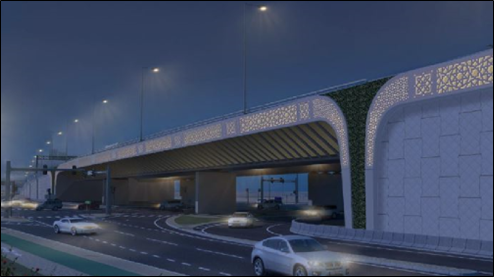
2. ground perspective of the project