TITLE OF THE MASTER THESIS: Delivering Under Pressure: Project and Contract Management in a Fast Track Airport Project A Case Study on Kuwait’s Airport Terminal 5
TITLE OF THE MASTER: Project and contract management in construction works
AUTHOR: Amer Atef I. Aldaraghma
TUTOR: Ing. Franchi
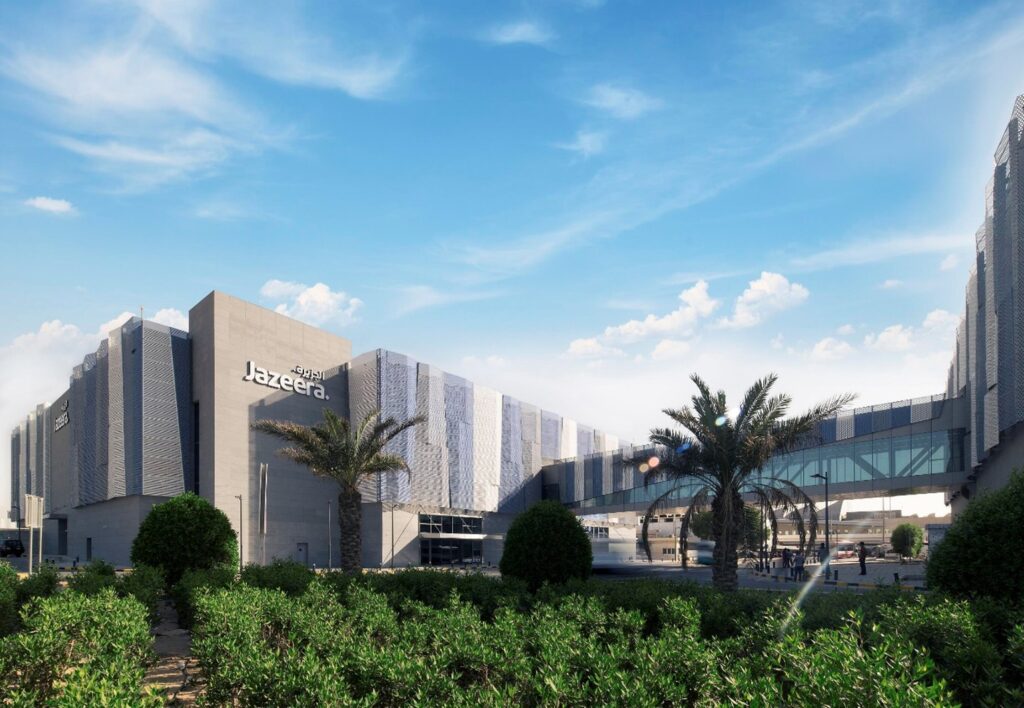
This thesis examines the construction of Kuwait’s Terminal 5 (T5), a fast-track airport project that was completed within a compressed timeline. T5 stands out as the first privately owned and operated airport terminal in the Middle East and is also part of Kuwait’s broader Vision 2035 infrastructure goals. The case study of T5 is a practical example of how rigorous project and contract management can lead to timely, dispute-free delivery.
The research explores the application of a hybrid management approach that merged traditional scheduling with Agile-inspired flexibility by drawing from firsthand site experience and internal project documentation (the screenshot of the Master Schedule below is an example). This approach was not pre-defined by formal methodologies but nonetheless, the strategies reflected principles outlined in PMI’s Project Management Body of Knowledge (PMBOK).
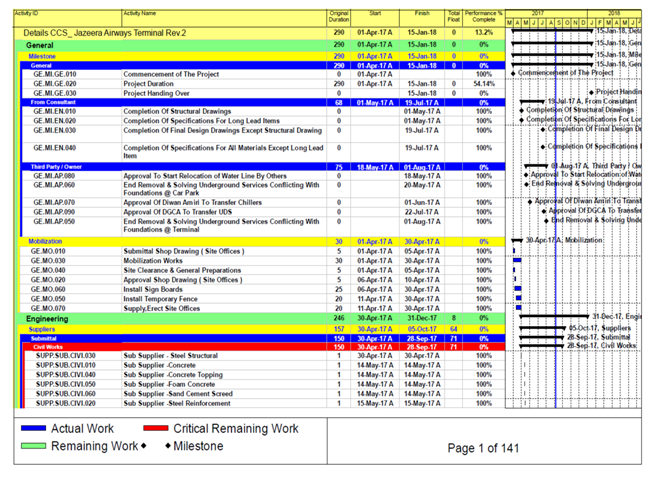
Analysis table number 1
The analysis of how specific technical strategies supported the management goals is an important dimension of the study. Techniques such as zone-based prioritization (see project shop drawing below), resource allocation, and just-in-time adjustments were applied to address shifting constraints, ranging from delayed authority inspections to procurement bottlenecks without jeopardizing progress or safety. For example, the prioritization of zones based on factors such as equipment lead times, approval cycles, and proximity to the airside boundary helped structure execution more effectively. In areas where government clearances were slower, parallel work was advanced elsewhere to avoid downtime. This level of responsive planning required close coordination among planning engineers, site engineers, and foremen, all operating within a culture that encouraged ownership and quick decision-making. The T5 project demonstrates how practical leadership and localized autonomy can coexist with top-down control, creating a more adaptive environment that still adheres to central project goals.
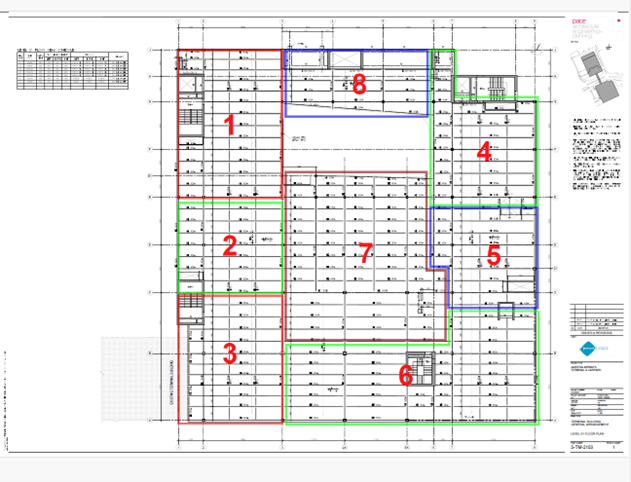
Analysis table number 2
One of the key takeaways from this research is that proactive coordination among stakeholders played a major role in the project’s success. Frequent and well-organized communication between the contractor, consultant, and owner’s representative made it easier to address technical issues as they came up. At the same time, involving regulatory authorities early in the process helped avoid delays by smoothing out the approval stages. This collaboration model played a critical role in managing the concurrent execution of structural works, MEP systems, and architectural finishes, despite parts of the design still being under review during construction. Subcontractor management was another decisive success factor such as clear delegation of responsibilities, coordinated sequencing and real-time monitoring allowed the project team to maintain tight control over interdependencies across trades and vendors. The thesis highlights how strong working relationships and decision-making authority at the zone level accelerated approvals, improved accountability, and reduced rework.
Special attention is given to the contractual framework, which was tailored to comply with local regulations while drawing influence from international standards such as FIDIC and NEC. The contract set out each party’s responsibilities in clear terms, established firm deadlines for notices and responses, and included forward-looking strategies to manage shared risks. Rather than being formalities, these terms played an active role in helping the team manage risks and avoid potential conflicts. The nature of the T5 contractual framework also facilitated ongoing communication and reinforced accountability throughout the project lifecycle. Given the overlapping phases in fast-track delivery, this contract model helped reduce confusion, keep expectations clear, and support consistent collaboration among stakeholders.
Beyond highlighting what contributed to the project’s success, the thesis also outlines several opportunities for refinement that may benefit future efforts. Due to the region’s volatility, the force majeure clause was primarily framed around conflict and war, leaving room for expansion to cover a wider range of risks. Widening its scope to include events such as pandemics, supply chain breakdowns, or natural disasters would reflect the kinds of disruptions that projects are more likely to face today, leading to fairer and more effective risk sharing. Additionally, applying Lean-Six Sigma principles may help reduce process inefficiencies and enhance interdepartmental coordination throughout the project lifecycle. Bringing in digital twin technology paired with live tracking and visual updates would allow teams to spot potential issues early while keeping stakeholders aligned through clearer and more streamlined communication.
The recommendations are shaped by firsthand project involvement and refined through comparison with widely used practices, aiming to help future teams build with fewer setbacks. By comparing the T5 experience with NEC and FIDIC frameworks, the study shows how international best practices can be adapted to fit local project conditions. This research highlights how early involvement of contractors, transparent compensation structures, and informal resolution methods helped keep the project on track, particularly under the time constraints of a fast-track schedule.
In summary, this thesis provides both practical and theoretical insight into the delivery of complex infrastructure under high-pressure conditions. By documenting how management teams adapted to shifting constraints, worked across organizational boundaries, and used contracts as tools rather than formalities, it reveals valuable lessons for the construction industry at large. The T5 project is not presented as a perfect model, but as a rich case of successful integration between planning and execution, policy and practice. These lessons are relevant for policymakers, consultants, and contractors involved in airport infrastructure, public-private partnerships, and other complex infrastructure projects in the Middle East and beyond.