

AUTHOR: Ahmad Alalim – Hasan Alkeesh.
TUTORS: Dott. Ing. G. Franchi
TITLE: Bim in Construction Management: Impact on Cost, Time, Quantity Accuracy, and Risk Management
MASTER: Bim for project and contract management in construction works – a.a (2024-2025)
The Libyan AEC sector remains heavily reliant on traditional 2D CAD workflows, which are increasingly ineffective at controlling costs and schedules, ensuring quantity accuracy, and managing risks. In recent decades, global practice has shifted toward Building Information Modeling (BIM) – a data-rich, model-driven process that integrates geometry, quantities, and schedules (the so-called 4D/5D/6D paradigm). However, in developing contexts like Libya, BIM adoption is still nascent due to skill and infrastructure barriers. This study assesses how applying a full BIM workflow to a typical Libyan residential project compares with conventional methods. We focus on a two-story house (Villa Gorji) – representative of Libyan practice – and evaluate key project metrics (cost, time, quantity, energy, and risk) under both workflows.
A structured case-study comparison was conducted. First, Villa Gorji was modeled using traditional 2D methods: architectural drawings in CAD, manual takeoff of quantities, and Excel-based cost and schedule calculations. Second, the same project was fully developed with a BIM workflow: architectural, structural, and MEP elements were created in Autodesk Revit (LOD 300) and exported via IFC. Quantities and costs were linked directly in PriMus-IFC (5D) and Termus-PLUS (6D energy analysis). A Navisworks model enabled 3D clash detection, and a Primavera P6 schedule was linked for 4D sequencing. Each workflow followed identical project requirements and scope, with detailed data collected on task durations, personnel hours, cost estimates, and output accuracy. By comparing outputs (tables, charts, and schedules) from the BIM and 2D processes on the same project, we isolated BIM’s effect on performance metrics.
Key Findings and Conclusions:
The BIM-based workflow dramatically outperformed the traditional approach in both time efficiency and cost accuracy. Routine tasks (quantity takeoff, scheduling updates, budget tracking) were completed up to 80% faster under BIM. Model-driven cost estimation proved far more reliable: BIM estimates tracked within 3–5% of actual costs, versus error margins of ±10% or more using manual bills of quantities. In the Villa Gorji case, the fully-integrated BIM estimate (€850,371) was about 9.9% lower than the manual total (€934,018), reflecting elimination of duplicate items and conservative allowances that inflated the 2D calculation. Quantities extracted from the BIM model were automatically propagated through all analyses, avoiding the hand-entry errors common in spreadsheets.
Coordination and risk metrics also improved under BIM. Automated clash detection in Navisworks identified conflicts (e.g. beam–wall interferences) during design, virtually eliminating the on-site surprises typical of the 2D approach. By enforcing data consistency across disciplines, BIM cut rework-related waste by roughly 10–15%. Stakeholders could inspect a single coherent model (a “visual, data-rich model”), enabling early discovery of issues and better communication. In practice this meant fewer RFIs and change orders: project duration was substantially shortened and schedule risk was reduced. For example, the BIM schedule showed a more balanced effort over design and procurement (per the MacLeamy curve), whereas the 2D plan front-loaded cost in construction.
Beyond cost and time, BIM facilitated advanced analysis. Exporting the Revit model to Termus-PLUS allowed a formal 6D energy simulation (APEs) that far exceeded anything possible with simple hand calculations. Thus, early-stage energy performance and sustainability assessments were readily integrated, supporting informed design decisions. Overall, the BIM workflow transformed the process from fragmented documents into an integrated, data-driven system. In summary, BIM’s automation and model coordination yielded faster delivery, higher cost predictability, and improved quantity accuracy, while its visualization and clash-checking features mitigated risks and improved quality. These results strongly confirm the study hypotheses (H1–H4): BIM significantly enhanced time efficiency, cost accuracy, and coordination quality compared to traditional 2D methods.
In conclusion, the Villa Gorji case demonstrates that embracing BIM can deliver clear performance gains in Libyan construction management. The findings advocate a pilot-then-scale BIM strategy: starting with projects like Villa Gorji can yield quick wins (7–10% cost savings and ~80% time reduction) that build confidence. Overcoming the remaining barriers (training, standards, infrastructure) will be essential, but the evidence shows that a BIM-enabled process offers a measurable competitive advantage – notably faster, more precise project delivery and built-in risk control – for developing markets such as Libya.
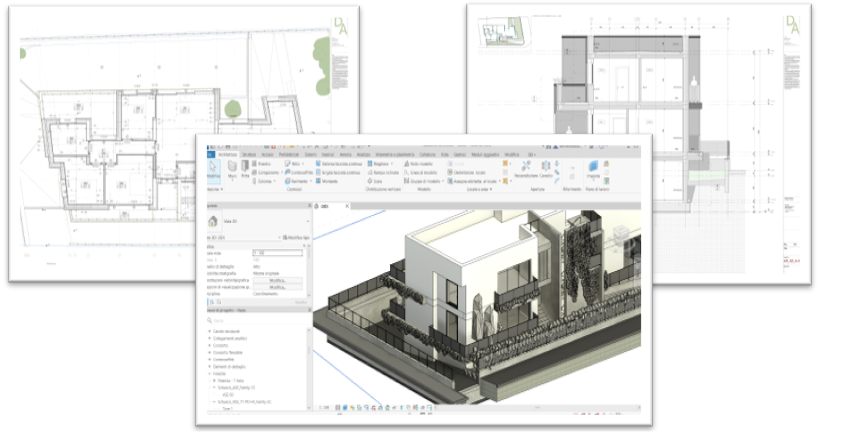
Figure 1: Revit modeling and plans of Villa Gorji
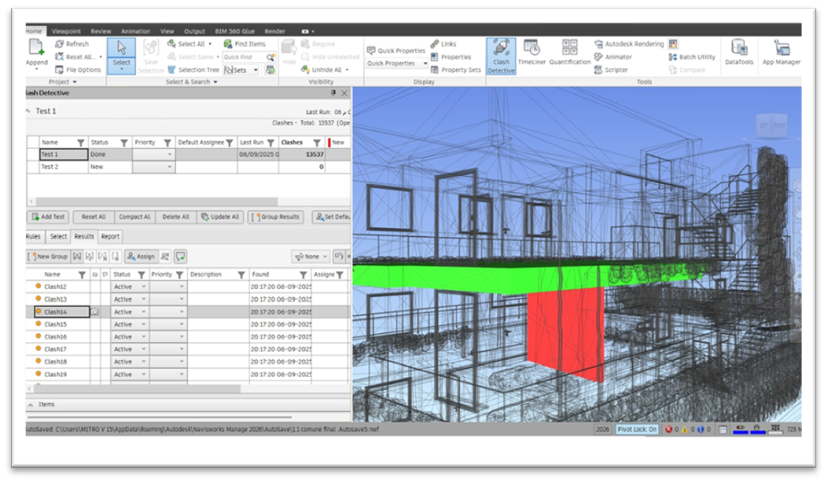
Figure 2: Clash detection in Navisworks showing a conflict between structural and architectural elements (green vs. red).