
AUTHOR: Arch. Khaoula Cheraief
TUTORS: Dott. Eng. Giovanni Franchi
MASTER: BIM Management in Construction Works
TITLE OF THE MASTER THESIS: From the executive project to the as-built phase of the area “EX-Falck” Sesto San Giovanni, COMPARTO UNIONE 0
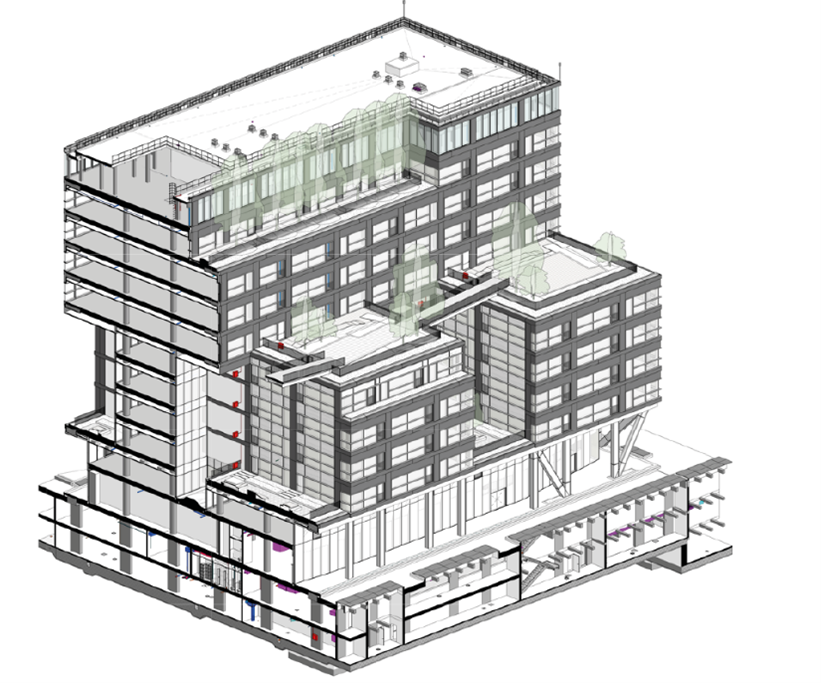
This thesis explores a critical and evolving phase of digital construction management: the transition from the executive design stage to the as-built phase, within the larger context of digitalization in the construction industry. Focusing on the redevelopment of “the Aree «Ex-Falck» in Sesto San Giovanni”, Milan—specifically the UMI1b office building, a 46-meter-tall structure—this research highlights the transformative role of Building Information Modeling (BIM) in connecting design with execution. Through this example, the thesis shows how BIM methods streamline workflows, improve the quality of information, and strengthen collaboration among all stakeholders.
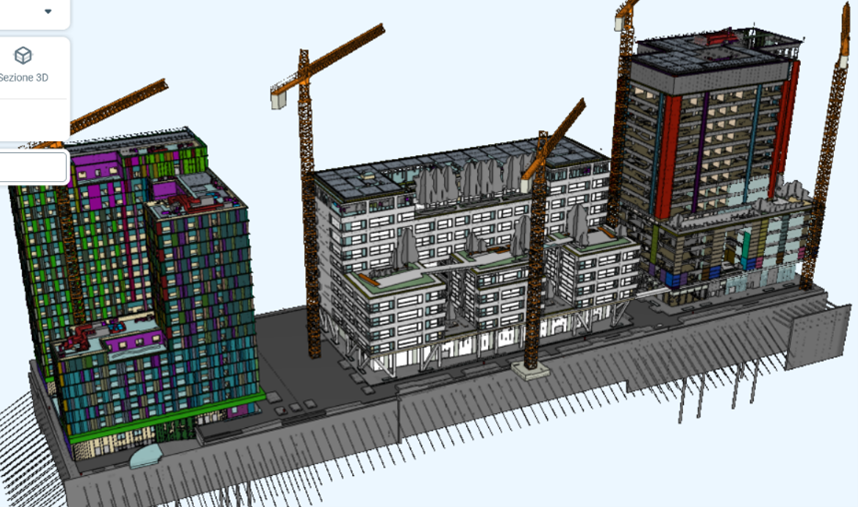
FIG 1. The project in Dalux
A central pillar of this research is the BIM authoring process, in which Autodesk Revit was used to create a highly detailed model for the construction phase. While special attention is given to the modeling of precast stair assemblies—due to their need for structured parametric organization and data consistency—the use of assembly codes extends to all model elements. These codes serve as logical identifiers, enabling the grouping and tracking of components within the model and throughout the various construction phases. Managing and updating these codes across the project lifecycle posed a significant challenge, which this thesis addresses through the development of three distinct and progressively advanced automation workflows.
The first solution, Workflow A, uses Dynamo, Revit’s visual scripting tool, to automate the updating of assembly codes by importing data from Excel. It reduces manual effort and streamlines repetitive tasks, but still requires users to manually run scripts and reload the model. As a result, it remains semi-automated and less effective for large-scale or collaborative projects. To address these limitations, Workflow B introduces an API-based solution using Python. This workflow creates a live link between the model and external data sources, allowing for real-time, fully automated updates of assembly codes. It improves accuracy and efficiency, particularly for managing large data sets, though it involves more complex setup and development. Workflow C builds on both previous approaches by integrating the automation directly into Revit via a custom PyRevit add-in. This solution combines the advanced capabilities of Workflow B with a user-friendly interface, enabling one-click updates from within Revit. It balances power and accessibility, making automation practical for both technical and non-technical users while maintaining high performance and scalability.
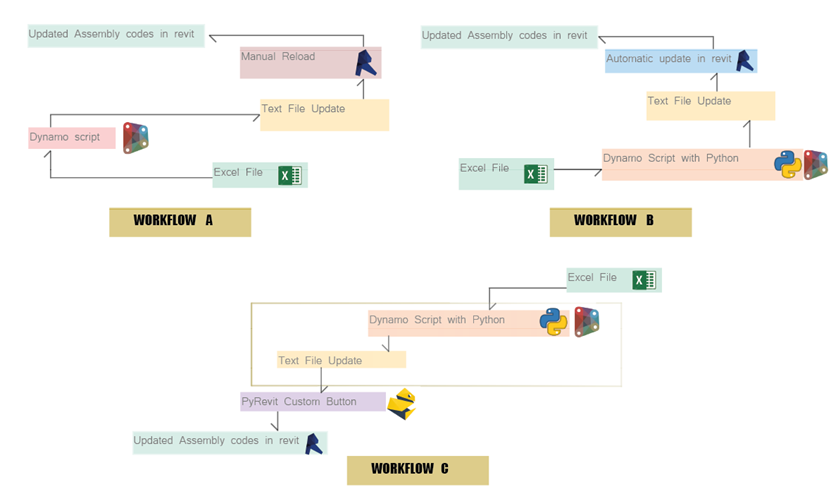
FIG 2. Comparative Analysis of BIM Workflows _ Final custom Button
Together, these workflows represent a progressive evolution from semi-automated scripting to fully integrated real-time tools, and were evaluated through a comparative analysis. Criteria such as processing time, implementation complexity, error mitigation, scalability, and user accessibility were considered. The results revealed that while Dynamo is suitable for small-scale applications and early-stage exploration, the API and PyRevit workflows are better suited for live project environments. PyRevit, in particular, emerged as the most balanced solution, offering high-performance automation without sacrificing ease of use or requiring advanced programming knowledge.
Beyond automation, the thesis delves into model verification and validation using Solibri Model Checker, with both first-level (discipline-specific) and second-level (federated model) clash detections applied. The identified issues—such as spatial conflicts between stair cores and architectural elements—were tracked and resolved through a structured RFI (Request for Information) process, conducted within a Common Data Environment (CDE)- DALUX. This step ensured compliance with project standards, reduced coordination errors, and improved communication among disciplines.
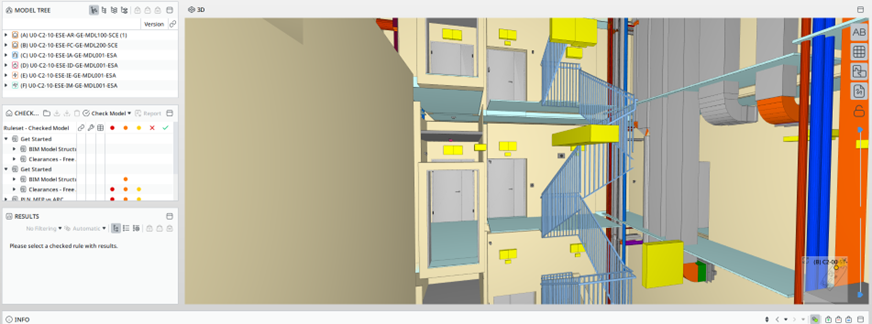
FIG 3. The Project in Solibri
In parallel, the research also details the integration of a Work Breakdown Structure (WBS) within the Revit model. Through custom scripts and parameter management, model elements were mapped to construction phases, allowing for dynamic filtering, real-time progress tracking, and alignment with the execution schedule. This transformation of the model from a static digital file into an active project management tool highlights the strength of BIM when it is used not only for design documentation, but also as a central platform for coordinating field execution.
The final portion of this thesis provides a comparative reflection on BIM-driven versus traditional construction workflows, emphasizing measurable advantages such as time and cost savings, improved data traceability, increased transparency, and reduced risks of miscommunication. The MI1b case study serves as a real-world validation of these benefits and demonstrates the tangible changes enabled through the adoption of structured BIM processes, especially when supported by automation and smart integrations.
In conclusion, this research demonstrates that BIM, when implemented with purpose and enhanced through automation, becomes far more than a modeling tool. It becomes digital infrastructure—an intelligent, collaborative, and data-driven system that supports every stage of a building’s life cycle, from executive design to as-built completion. By integrating structured authoring, flexible automation, rigorous model validation, and schedule-oriented planning, this thesis presents a holistic and practical methodology that can be adopted across a wide range of construction projects. It contributes not only to the academic study of BIM management but also offers concrete strategies for professionals seeking to digitize and streamline their workflows in the ever-evolving construction industry.