
MASTER: Contract, claim and delay management in construction works
AUTHOR: Amjad Nawaz
TUTOR: Eng. Giovanni Franchi
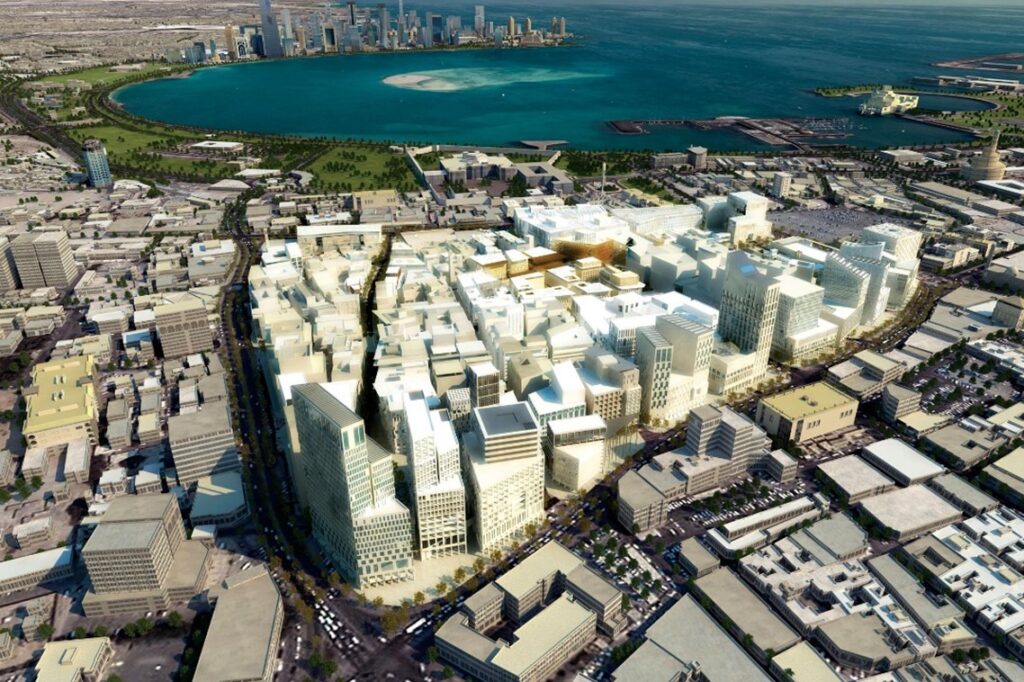
This case study for the Master’s thesis in Contract, Claim, and Delay Management in Construction Works encompasses the preparation of a Contractor’s claim for Extension of Time and associated costs due to the extended period for the Project of “Enabling and Raft Works of Phase 4” in the Msheireb Downtown Doha, Qatar. The Msheireb Downtown Doha, located in central Doha, is a state-of-the-art, LEED-certified project intended to provide world-class facilities to the residents of the Sate of Qatar. The Contract covered enabling and raft works for Phase 4, including shoring, dewatering, piling, waterproofing, and other construction tasks. It was contracted to Redco International Trading and Contracting W.L.L. The total Contract Price was QAR 135,225,922 under a re-measured contract based on the FIDIC Conditions of Contract for Construction (First Edition, 1999).
The project was significantly impacted by multiple Employer’s Delay Events that substantially affected the Time for Completion. The project’s complexity stems from its location within an area surrounded by significant urban infrastructure and other contractors working in the same vicinity. The Contractor was required under the Contract to coordinate with multiple adjacent projects, including the nearby rail project and other phases of the Project, necessitating seamless collaboration and strict adherence to schedules. However, the Contractor encountered five key delay events that were beyond the control of the Contractor:
1. Delayed Provision of Permits: The Employer was responsible for securing several key permits, such as building, excavation, and disposal permits as the Employer was obliged pursuant to Sub-Clause 1.13 [Compliance with Laws] to provide the necessary permits for the project. Failure to do so constitutes a breach of the contract. These were either delayed or incomplete, forcing the Contractor to initiate work without proper authorizations, resulting in disruptions and double-handling of materials. Despite notifying the employer and engineer of these issues, delays persisted, pushing back critical milestones. In addition, the Contractor’s rights under Qatari Law No. 22 of 2004, particularly Article 686, further strengthen its claim, as the Employer’s failure to fulfill its legal and contractual obligations, such as obtaining permits, shifts the liability for delays to the Employer.
2. Engineer’s Instructions: Multiple instructions issued by the Engineer caused substantial delays. Instructions to hold certain works, such as the secant pile construction along the interface with other sections, impeded progress. Revised design bulletins issued late in the project also impacted the project’s sequence of works. The Engineer’s changing instructions, including new waterproofing specifications and design modifications, required reworking of previously completed tasks and caused major schedule shifts. The Engineer has the authority to issue instructions pursuant to Sub-Clause 3.3 [Instructions of the Engineer] of the Contract read in conjunction with Sub-Clause 13.1 [Right to Vary] of the Contract before the issuance of Taking-Over Certificate pursuant to Sub-Clause 10.1 [Taking-Over of the Works and Sections] of the Contract. However, if such instructions cause changes to the work scope or lead to delays, the Contractor is entitled to an EOT and additional payments for the varied works. The Contractor must adhered to the requirement of notifying the Employer of the time and cost impact of the Engineer’s instructions.
3. Delayed Approval of Contractor’s Documents: Critical documents submitted by the Contractor, including proposals for replacing the diaphragm wall with an alternative contiguous pile design, encountered extended approval delays. The lack of timely responses from the Engineer resulted in substantial delays as the Employer was responsible to respond within 14 days in accordance with the Project Specification and Conditions of the Contract.
4. Delayed Possession of Site: The Employer failed to provide certain sections of the site within the contractual milestones. The site was partially occupied by adjacent contractors, which delayed excavation and piling activities. The Contractor’s planned sequencing of works was delayed and disrupted, further exacerbating the delays. The Employer must give the Contractor possession of the site within the agreed timeline in accordance with Sub-Clause 2.1 [Right of Access to the Site] of the Conditions of Contract.
5. Issues Related to Nominated Subcontractors: Two major subcontractors, M/s Teyseer Trading for waterproofing and M/s Ready Mix Qatar for concrete supply, introduced significant challenges to the Project. Both subcontractors, nominated by the Employer, refused to enter into binding agreements under the Provisions of the Contract. Delays in concluding commercial agreements with the subcontractors affected the Contractor’s ability to execute waterproofing works on schedule as the Contractor was unable to refuse those Nominated Subcontractor in accordance with Sub-Clause 5.2 [Objection to Nomination] of the Contract and could not employ the other subcontract.
The Contractor’s claim was supported by the Provisions of the Contract, particularly clauses related to the employer’s obligations, delay events, variations, and the right to EOT and additional payments. The Claim also references local Qatari law, particularly Law No. 22 of 2004, which further strengthens the Contractor’s entitlement to compensation for delays that were not within its control. Specific clauses of the Contract, such as Sub-Clause 8.4 (Extension of Time), Sub-Clause 20.1 (Contractor’s Claims), and the Employer’s obligations under Sub-Clause 1.13 (Compliance with Laws), were highlighted as key justifications for the Claim.
The delay analysis used the “As-Planned Vs As-Built” method to assess the impact of each Employer’s Delay Event (EDE) on the project. Fragnets with regard to additional works or changes in the scope of work were developed for each delay event, linking it to the impacted activities in the approved Detailed Schedule of Work by the Engineer. The analysis concluded that the Contractor was entitled to an extension to the Time for Completion for each of the Employer’s Delay Events.
The Contractor claimed compensation for the additional costs incurred due to the delays attributable to the Employer. These included increased costs related to site running expenses, additional labor and equipment costs associated with the temporary works, and the need to implement mitigation measures. The calculation of these cost was based on the guidelines provided by the Royal Institution of Chartered Surveyors (RICS) for time-related costs. The Contractor maintained records of these expenses and asserted its right to recover the costs in accordance with the Contract.
Mitigation measures were also employed by the Contractor to minimize delays, including the re-sequencing of works, double handling of materials, and expedited processes for alternative solutions as it was the Contractor’s obligation under the Contract. However, the Contractor asserts that many delays were beyond its control, caused by Employer and engineer actions, as well as the late involvement and non-cooperation of nominated subcontractors.
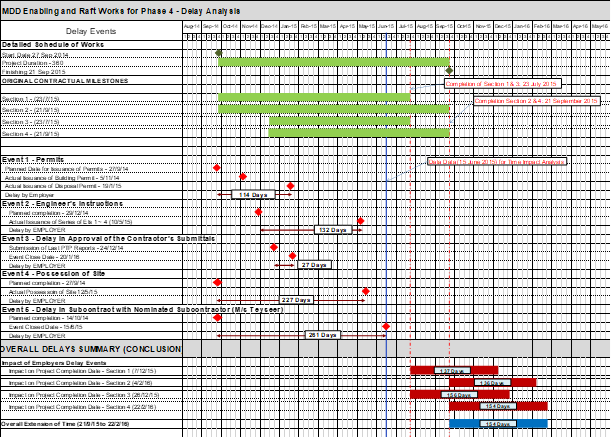
Graphical Summary of Delay Analysis